
Memory matching game tips: remember positions and use a steady route
Remembering a symbol is only half the job in Find the Pair. You also need to remember where it was. A simple route through the board can turn random guesses into useful observations. To try it, pick Classic mode and the sixteen-card board.
Play Find the Pair: Reef Party →Know what counts as a move
In Classic mode the sixteen-card board holds eight matching pairs. One move means opening two different face-down cards. A matching pair swims off to the party; a mismatch turns face down again. The move counter changes after the second card, not after every click.
Eight moves is the theoretical minimum, with a match on every attempt. You cannot expect that on a fresh random layout, even though Mimi shows every card briefly at the start.
Give positions short names
Imagine rows A to D from top to bottom and columns 1 to 4 from left to right. The upper-left card is A1; the lower-right card is D4. Simple descriptions such as “top left” work too if they are easier for you.
Remember a pair of facts: “turtle at A1” or “seahorse at C3”. “I saw a turtle somewhere” is harder to use. These coordinates are a memory aid, not labels displayed in the game.
Explore in a steady order
Try moving left to right across each row when you need to reveal an unknown card. This does not predict the shuffle; it helps you track which positions you have already seen.
If your first card is a turtle and you know where the other turtle is, use that position for your second choice. Otherwise, spend the second reveal on an unfamiliar card.
- Reveal the next unknown position on your route.
- Name its symbol and position to yourself.
- Choose a known matching card if you remember one; otherwise explore a new card.
- After a mismatch, remember both positions before moving on.
Turn a mismatch into information
Suppose your first turn reveals a turtle at A1 and a seahorse at A2. On the next turn, A3 is another turtle. Your second choice should now be A1: you already know that match.
When you are unsure, treat the position as a guess rather than a fact. A wrong guess can still help: update your mental map instead of repeating the same uncertain choice.
Use the short reveal pause
After a mismatch, both cards stay visible briefly before turning over. Your next tap closes them right away, so do not rush: use the moment to remember the two positions.
Matched cards are no longer candidates. Focus on the remaining face-down positions rather than trying to recall the entire original board.
Compare several rounds
Compare your move count after finding all eight pairs; the game keeps your record for each board size. Play a few fresh rounds: one random layout may be easier than another, so a single result says little about improvement.
This version has no compulsory timer. Use a mouse, touch, or arrow keys and Enter on a keyboard. It is a game about remembering this board, not an intelligence test or a medical training programme.
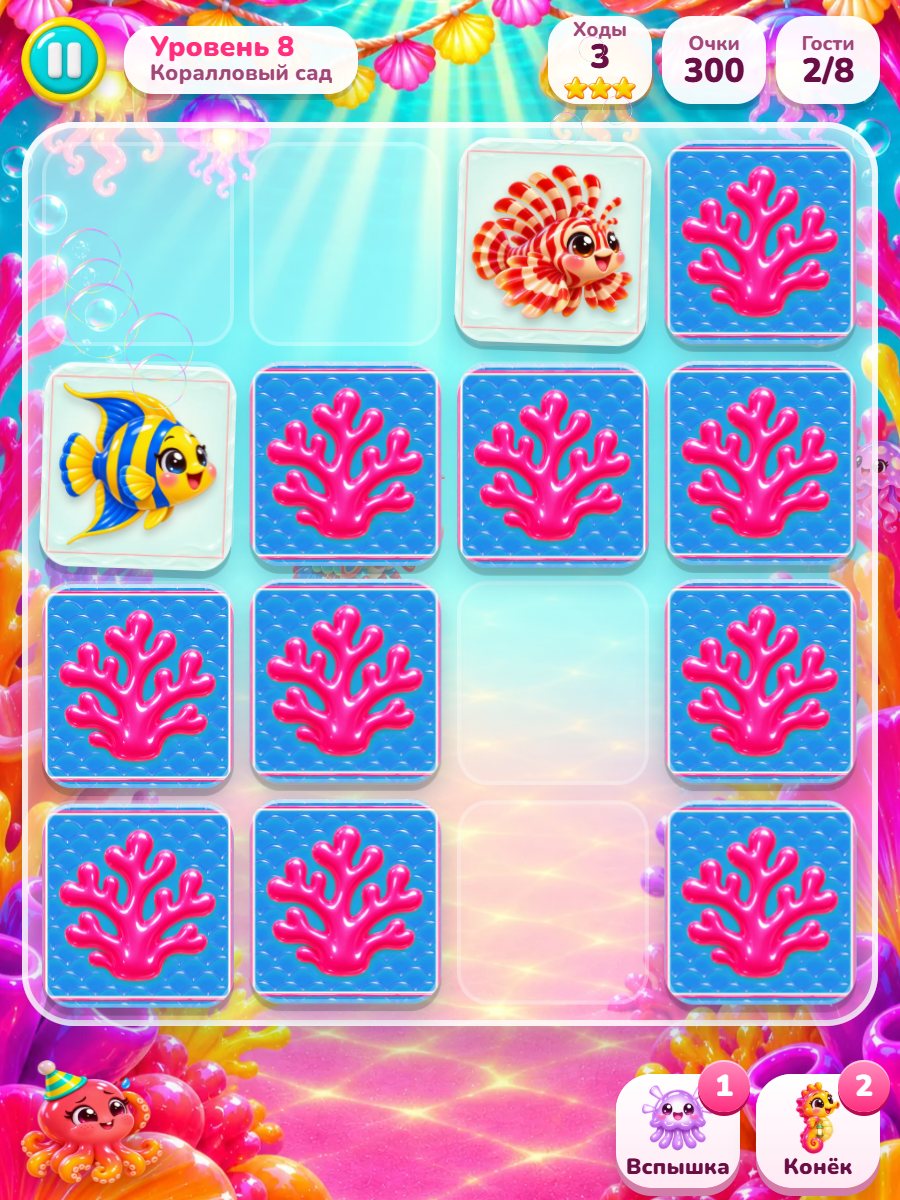
A look inside the game
Put it into practice
The game opens in your browser. You do not need to install it or create a player account.
Open the game →More game guides